The craft
Six classic grand illusions
Levitation, the saw, the vanish, the substitution trunk, the escape and the spirit cabinet: where the stock pieces of a big illusion show come from.
Choose your show night ↗Quick answer
Most grand-illusion shows draw on a handful of classics: the floating person, the sawing, the vanish and appearance, the substitution trunk, the escape and the cabinet. Each has a documented history going back to the 19th or early 20th century.
A shared stock of effects
Magicians argue about how to categorise effects, but the broad families are familiar: making something disappear or appear, transforming one thing into another, destroying and restoring, moving something from one place to another, escaping, defying gravity and passing solid through solid. A grand-illusion show takes those families and builds them big enough for a theatre. The six classics below are the ones people most often picture, and knowing where they come from makes a modern show more fun to watch. No list can say which of them a particular production uses on a given night; that belongs to the show.
Levitation
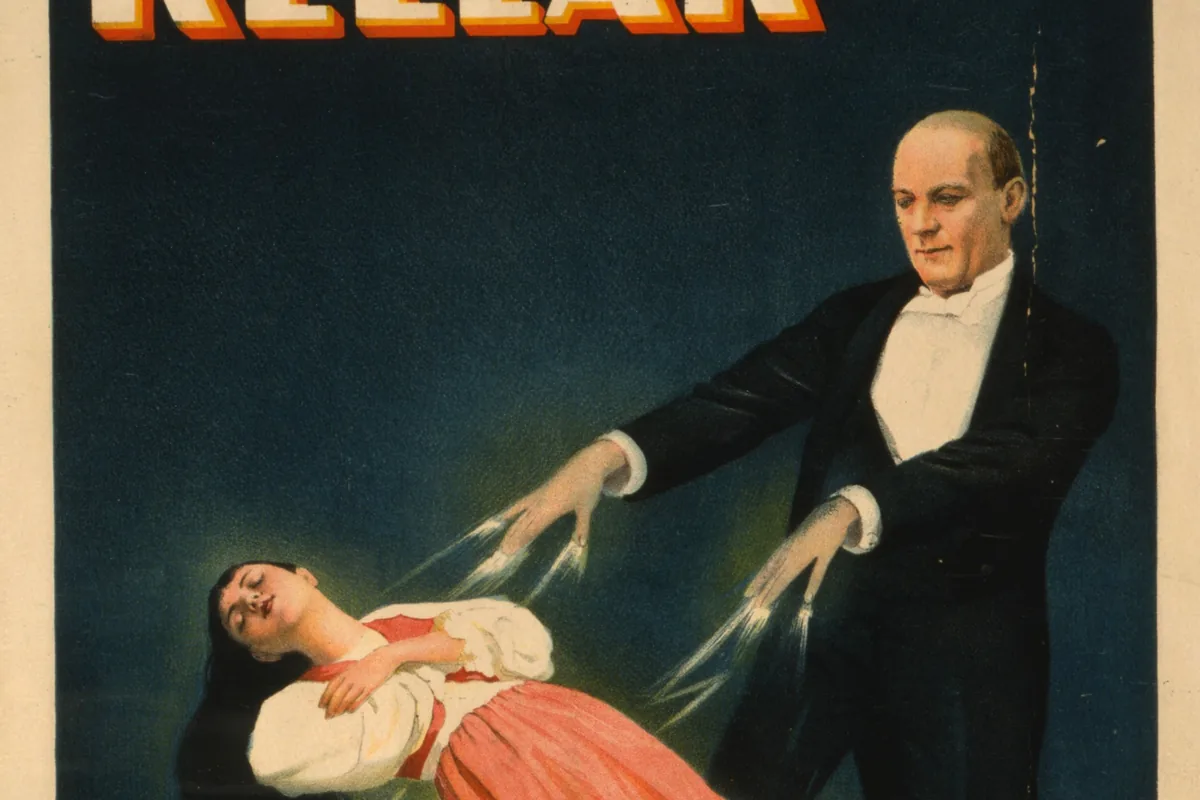
In a levitation illusion a person or object appears to float. The Asrah levitation, in which an assistant under a cloth rises, hangs and then vanishes when the cloth is pulled away, is credited to Servais Le Roy, who first performed it with his wife in 1902. Harry Kellar's floating princess came with a flourish that is still copied: he passed a hoop back and forth along her body to show that she was not hanging from anything. Maskelyne and Cooke, at London's Egyptian Hall, counted levitation among their best-known illusions.
The saw
Sawing illusions have a disputed early history, but the modern story starts in London. P. T. Selbit's Sawing Through A Woman was shown publicly on 17 January 1921 at the Finsbury Park Empire, with his assistant locked out of sight in a crate and spectators holding ropes tied to her. Later that year Horace Goldin, working in the United States, presented the version that looks familiar now, with the assistant's head, hands and feet outside the box. In 1965 Robert Harbin invented the Zig Zag Girl, which divides an assistant into thirds.
The vanish and the appearance
Disappearing and appearing are the simplest effects to describe and among the hardest to do well on a large scale. On a stage they take the form of empty cabinets that suddenly hold people, cloths pulled away from spaces where someone stood, and assistants who arrive in places they cannot have reached. The effect also works in reverse as a production, with a whole troupe bursting out of a box shown empty a moment before. Modern performers have vanished objects as large as the Statue of Liberty and a space shuttle.
The substitution trunk
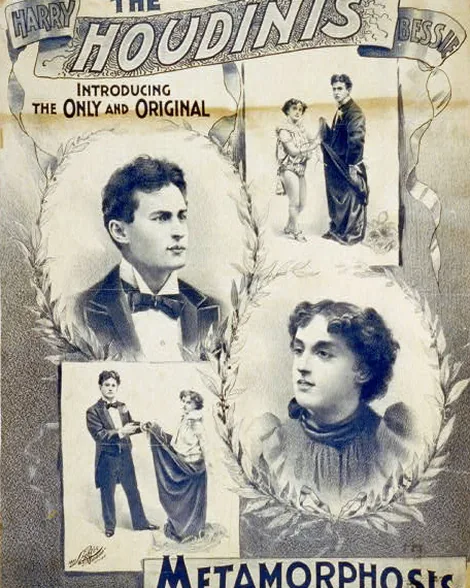
Metamorphosis, which magicians shorten to the sub trunk, is a stage illusion in which the magician and an assistant swap places. The assistant is locked in a trunk, often after being restrained; the magician stands on top and lifts a curtain; when it drops, the assistant is on the trunk and the magician is inside, restrained in the same way. John Nevil Maskelyne invented it, Harry Houdini made it famous with his wife Bess, and later performers have staged it underwater or high above the stage.
The escape and the cabinet
Escaping from restraints began as a hidden skill. In the 1860s the Davenport Brothers freed themselves from rope ties inside a cabinet and presented the results as spirit phenomena; illusionists including John Nevil Maskelyne worked out the method and re-created it as skill. It took another thirty years before escaping was shown openly as an act in its own right, and Harry Houdini did most to make escapology an entertainment, with handcuffs, straitjackets, mail bags and his Chinese Water Torture Cell.
Frequently asked questions
Who invented the substitution trunk?
John Nevil Maskelyne, though Harry Houdini made it famous.
When was sawing a woman in half first shown publicly?
P. T. Selbit showed his version to the public at the Finsbury Park Empire in London on 17 January 1921.
Sources